About Lisbon
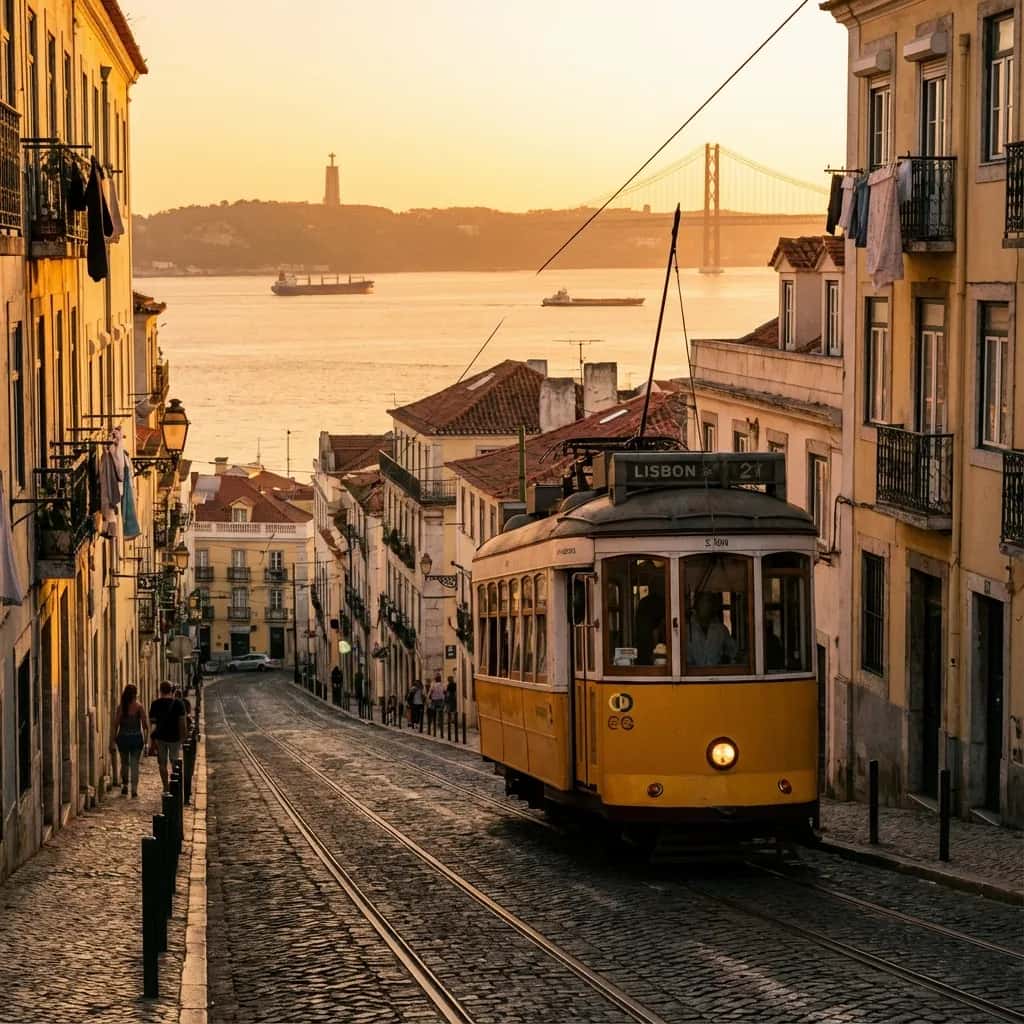
Lisbon (Portuguese: Lisboa) is the capital of Portugal situated on seven hills at the wide mouth of the river Tagus (Tejo) where it meets the Atlantic Ocean. With 545,000 residents in the city and 3.0 million in the Lisbon Region (2024) and a thriving mix of Portugal's rich history and vivid contemporary culture, Lisbon enchants travellers with its white bleached limestone buildings, intimate alleyways, and an easy going charm that makes it a popular year round destination. Greater Lisbon comprises many other splendid tourist destinations such as the UNESCO World Heritage Site of Sintra, the seaside resorts of Estoril, Cascais, the world class museums, or Almada famous for its hilltop Cristo Rei statue, all of which are connected with Lisbon by excellent public transportation links.
Source: Wikipedia
Essential Information
Currency
Euro (EUR)
Symbol: €
Language
Portuguese
Phone Code
+351
International dialing code for Portugal
Driving
Drive on the right
Standard for Portugal
Region
Europe
Southern Europe
Connectivity
All of Lisbon has 4G from all Portuguese carriers. As of Jan 2023, 5G coverage is quite broad in most popular areas. Deep inside some older buildings, or underground you might find coverage to be spotty.
How to Get to Lisbon
Transportation options and arrival information
TheLisbon Airportserves the city. If no flight fits, you can take a plane toPortoorFaro. Both cities have direct trains and buses to Lisbon.
Getting Around Lisbon
Local transportation and navigation tips
Lisbon has a very efficient public transport network that covers the entire city in addition to the surrounding areas. It consists of a bus and tram network operated byCarris, the separately-runLisbon Metro[dead link]underground rail, as well as commuter trains and ferries which connect Lisbon to its neighbouring suburbs. Additionally, Carris operates three unique funiculars and one public elevator that function as parts of the public transportation system.
Safety in Lisbon
Very High Safety (Global Peace Index: 1.301)
About the Global Peace Index: Global Peace Index measures peacefulness on a scale of 1 (most peaceful) to 5 (least peaceful)
Lisbon is generally safe, but use common sense precautions, especially at train stations and on public transport.
Where to Stay in Lisbon
Accommodation tips and recommendations
Finding a decent sleeping place in the centre should not be a big problem. There is a tourist service centre in the airport, where a room can be booked for you. Expect to pay between at least €55 for a double room. If you are in Lisbon for sightseeing (especially for your first visit), the best location is along the route of tram #28 (seeofficial map of the route). This especially works if you are with a baby stroller, as it will save from huge part of hill-climbing.
UNESCO World Heritage Sites
5 protected sites near Lisbon


Things to See in Lisbon
19 landmarks and points of interest
Bust of António Pedro
statue in Lisbon, Portugal
Castle of Almada
building in Almada, Setúbal District, Portugal
Church of Nossa Senhora da Conceição Velha
church in Lisbon, Portugal
Igreja da Memória
church building in Ajuda, Lisbon District, Portugal
Igreja da Póvoa de Santo Adrião
church building in Odivelas, Lisbon District, Portugal
Igreja de Chelas
church building in Lisbon, Lisbon District, Portugal
Lisbon Central Mosque
building in Lisbon, Lisbon District, Portugal
Madre de Deus Convent
monastery in Lisbon
Museum of the Orient
asian art museum in Portugal
National Museum of Natural History and Science, Lisbon
museum in Lisbon, Portugal
Palace of Ajuda
building in Lisbon, Lisbon District, Portugal
Palace of the Counts of Azambuja
building in Lisbon, Lisbon District, Portugal
Source: Wikidata
Ready to Explore Lisbon?
Find the perfect time to visit and discover all that Lisbon has to offer.