
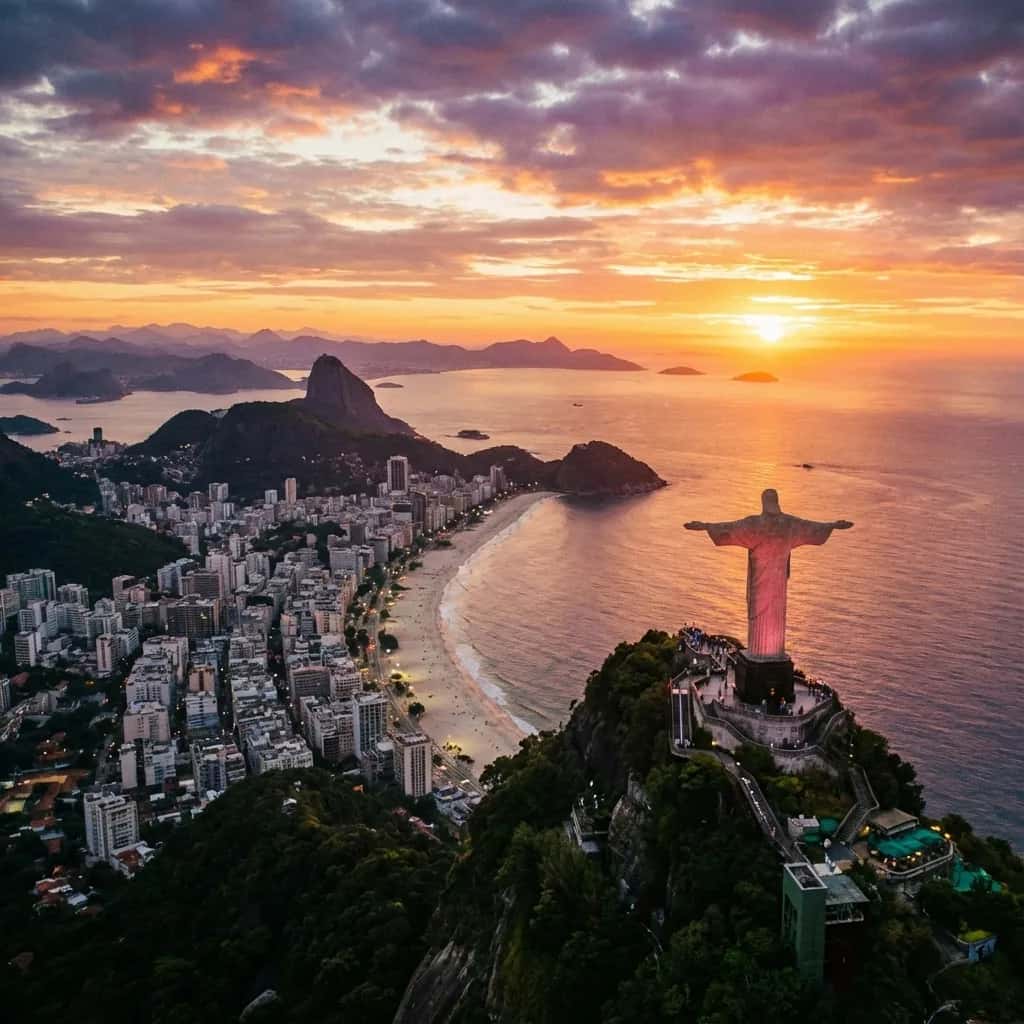
About Rio de Janeiro
Rio de Janeiro is the second largest city in Brazil, on the South Atlantic coast. Rio is famous for its breathtaking landscape, its laid-back beach culture and its annual carnival. The "Carioca Landscapes between the Mountain and the Sea" has been inscribed on the UNESCO World Heritage list. The harbour of Rio de Janeiro is comprised of a unique entry from the ocean that makes it appear as the mouth of a river. Additionally, the harbor is surrounded by spectacular geographic features including Sugarloaf mountain at 395 meters (1,296 feet), Corcovado Peak at 704 meters (2,310 feet), and the hills of Tijuca at 1,021 meters (3,350 feet). These features work together to collectively make the harbor one of the Seven Natural Wonders of the World. Rio de Janeiro hosted many of the 2014 FIFA World Cup games, including the final. It also hosted the 2016 Summer Olympics and Paralympics, becoming the first South American city to host the Summer Olympics.
Source: Wikipedia
Essential Information
Currency
Brazilian real (BRL)
Symbol: R$
Language
Portuguese
Phone Code
+55
International dialing code for Brazil
Driving
Drive on the right
Standard for Brazil
Region
Americas
South America
How to Get to Rio de Janeiro
Transportation options and arrival information
Rio is one of the country's major transportation hubs, second only to São Paulo.
Getting Around Rio de Janeiro
Local transportation and navigation tips
Rio de Janeiro possesses an extensive and complex, highly multi-modal public transportation system, adapted to the city's unique topography – large areas covered by mountains surrounded by pockets of densely populated flat lands. Among the public transportation modes, there is subway, heavy rail, light rail, bus rapid transit, local buses, microbuses, cable cars and ferry boats.
Safety in Rio de Janeiro
Moderate Safety (Global Peace Index: 2.465)
About the Global Peace Index: Global Peace Index measures peacefulness on a scale of 1 (most peaceful) to 5 (least peaceful)
Rio de Janeiro's reputation as a dangerous city was cemented internationally by the critically acclaimed movieCidade de Deus— a reputation that's not entirely unwarranted.
Where to Stay in Rio de Janeiro
Accommodation tips and recommendations
In theZona Sul, you will find Rio's fanciest and most popular hotels along the beaches of Ipanema and Copacabana, but there are lots of small, cheap, clean hotels around Flamengo and Catete. The street in front of the strip of tourist hotels in Copacabana can be seedy, due to both garishly-dressed tourists, and a few opportunistic locals ready to take advantage of them. The apart-hotels in Ipanema are a much more pleasant alternative, being both better appointed and in a nicer neighborhood with
UNESCO World Heritage Sites
1 protected sites near Rio de Janeiro

Things to See in Rio de Janeiro
20 landmarks and points of interest
Bica da Rainha
Monument in the city of Rio de Janeiro
Brazilian Historic and Geographic Institute
archive in Rio de Janeiro, Rio de Janeiro
Carmen Miranda Museum
museum in Rio de Janeiro, Brazil
Catete Palace
palace in Rio de Janeiro, Brazil
Cinelândia District
neighborhood in the central region of Rio de Janeiro city
Copacabana Stadium
former Olympic beach volleyball venue in Rio de Janeiro, Brazil
Estádio da Rua Bariri
football stadium in Rio de Janeiro, Brazil
Largo do Machado
square in Rio de Janeiro
Maracanã Stadium
stadium in Rio de Janeiro, Brazil
Marak'anà Village
Urban indigenous village and historical site registered by State Institute of Cultural Heritage of Rio de Janeiro in the city of Rio de Janeiro, Rio de Janeiro, Brazil
Museu da Imagem e do Som do Rio de Janeiro
museum in Rio de Janerio, Brazil
Paris Square
square in Rio de Janeiro, Brazil
Source: Wikidata
Ready to Explore Rio de Janeiro?
Find the perfect time to visit and discover all that Rio de Janeiro has to offer.