About Warsaw
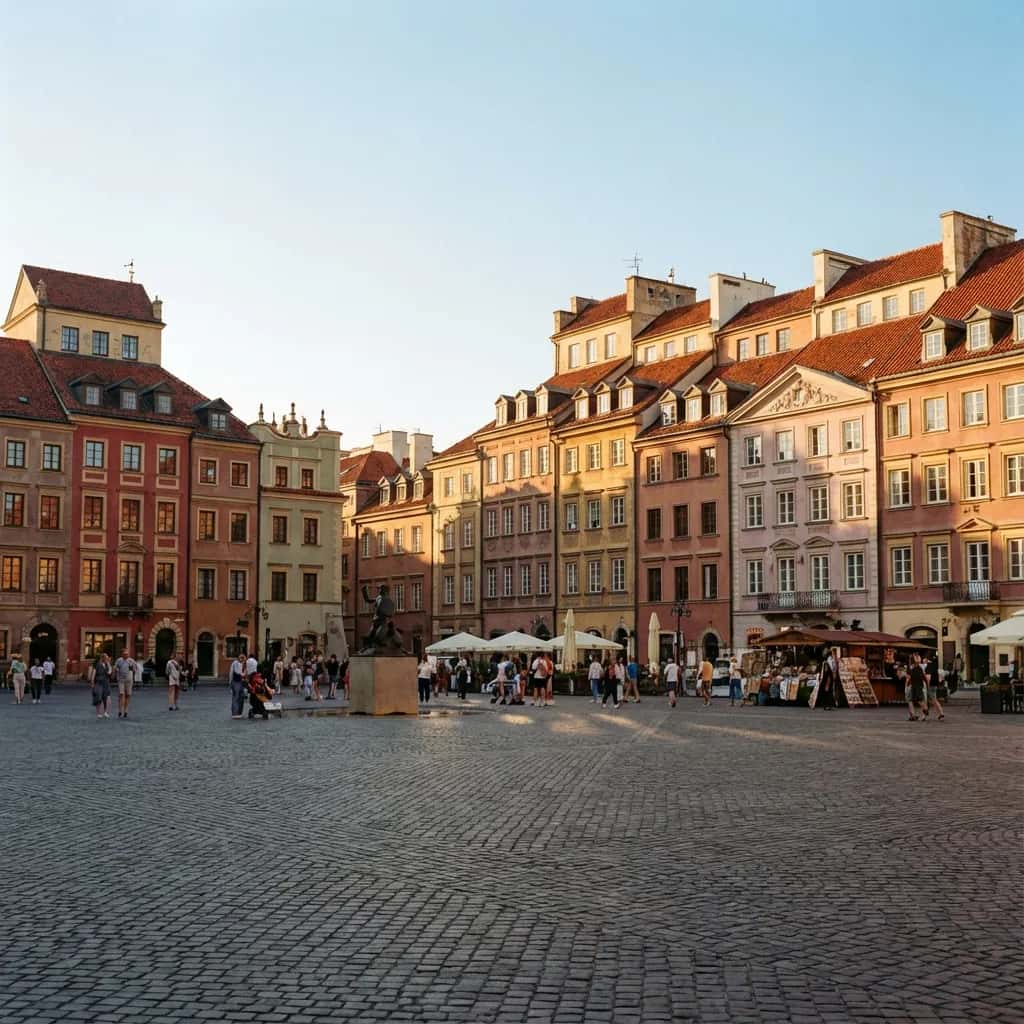
Warsaw (Polish: Warszawa) is Poland's capital and largest city. Warsaw is a bustling metropolis and one of the European Union's fastest-developing capitals and the Union's ninth most populous urban centre. It has a mixture of new and old in its eclectic architectural mix, and is constantly changing. There is a large variety of museums, galleries and other tourist attractions, and there is always something happening throughout the year. While sprawling, it is quite easy to navigate for tourists thanks to a good public transit system, and most important sights are quite close to each other. There is no shortage of accommodation options and a wide choice of restaurants and bars. Warsaw's nightlife is also on the rebound, and a reborn cafe culture has taken over the city.
Source: Wikipedia
Essential Information
Currency
Polish złoty (PLN)
Symbol: zł
Language
Polish
Phone Code
+48
International dialing code for Poland
Driving
Drive on the right
Standard for Poland
Region
Europe
Central Europe
Connectivity
Free wi-fi is widespread in Warsaw. Municipal hot-spots (freewifi.waw.pl) are free of charge and available in over 150 localities throughout the city. Those include the Old Town, most public parks, major city squares, the vicinity of most public buildings and museums. They are all marked by blue or purple "HOT SPOT UM-Warszawa" plaques hanging on street lamps. It is also available in over 300 city buses and some tramways (marked with a white and blue wi-fi icon at the doors).
How to Get to Warsaw
Transportation options and arrival information
Warsaw has two airports: Chopin (WAWIATA) is the main one 8 km south, and Modlin (WMIIATA) 40 km north is only used by Ryanair.
Getting Around Warsaw
Local transportation and navigation tips
The public transport system in Warsaw is generally well-developed, with some200 bus routesand30 tram lines. The route descriptions on the tram stops are easy to follow (although bus stop notices are more complex), but it can last longer, however, to travel between destinations far from the city center. Warsaw has two underground metro lines, one going from south to north on the left bank, and the other from the east to the west. There are also some regional urban rail services (Polish:Szybka Kol
Safety in Warsaw
High Safety (Global Peace Index: 1.552)
About the Global Peace Index: Global Peace Index measures peacefulness on a scale of 1 (most peaceful) to 5 (least peaceful)
Warsaw is a safe city overall. The city center has a strong police presence and is generally a very safe area. The Praga districts used to be dangerous, but this is generally more hype than reality. Of course, it would be wise to exercise a little extra caution if you're in an area you do not know well. The bus and rail stations can be a magnet for homeless and drunkards, who, for the most part, will leave you alone.
Where to Stay in Warsaw
Accommodation tips and recommendations
There are plenty of accommodation options in Warsaw at all budget levels. The most accommodation options are inŚródmieście,Wola, andMokotów. There are also many business travel hotels inWłochy, near the airport.
Things to See in Warsaw
18 landmarks and points of interest
All Saints Church, Warsaw
church in Warsaw, Poland
Artur Zawisza Square, Warsaw
square in Warsaw
Church of the Ascension of Christ in Warsaw
church building in Warsaw, Poland
Church of the Immaculate Conception of the Blessed Virgin Mary, Warsaw
church in Warsaw, Poland
Grunwaldzki Square in Warsaw
urban square in Warsaw, Poland
Iron-Gate Square
square
Moczydełko Park
park in Warsaw, Poland
Mokotów Field
park in Warsaw, Poland
Monument to Stefan Rowecki "Grot"
monument in Warsaw, Poland
Museum of the Earth of Polish Academy of Sciences
museum in Poland
Na Rozdrożu Square in Warsaw
urban square in Warsaw, Poland
Palace of the Ministry of Revenues and Treasury
palace
Source: Wikidata
Ready to Explore Warsaw?
Find the perfect time to visit and discover all that Warsaw has to offer.